Safety and Security on Bus and Rail
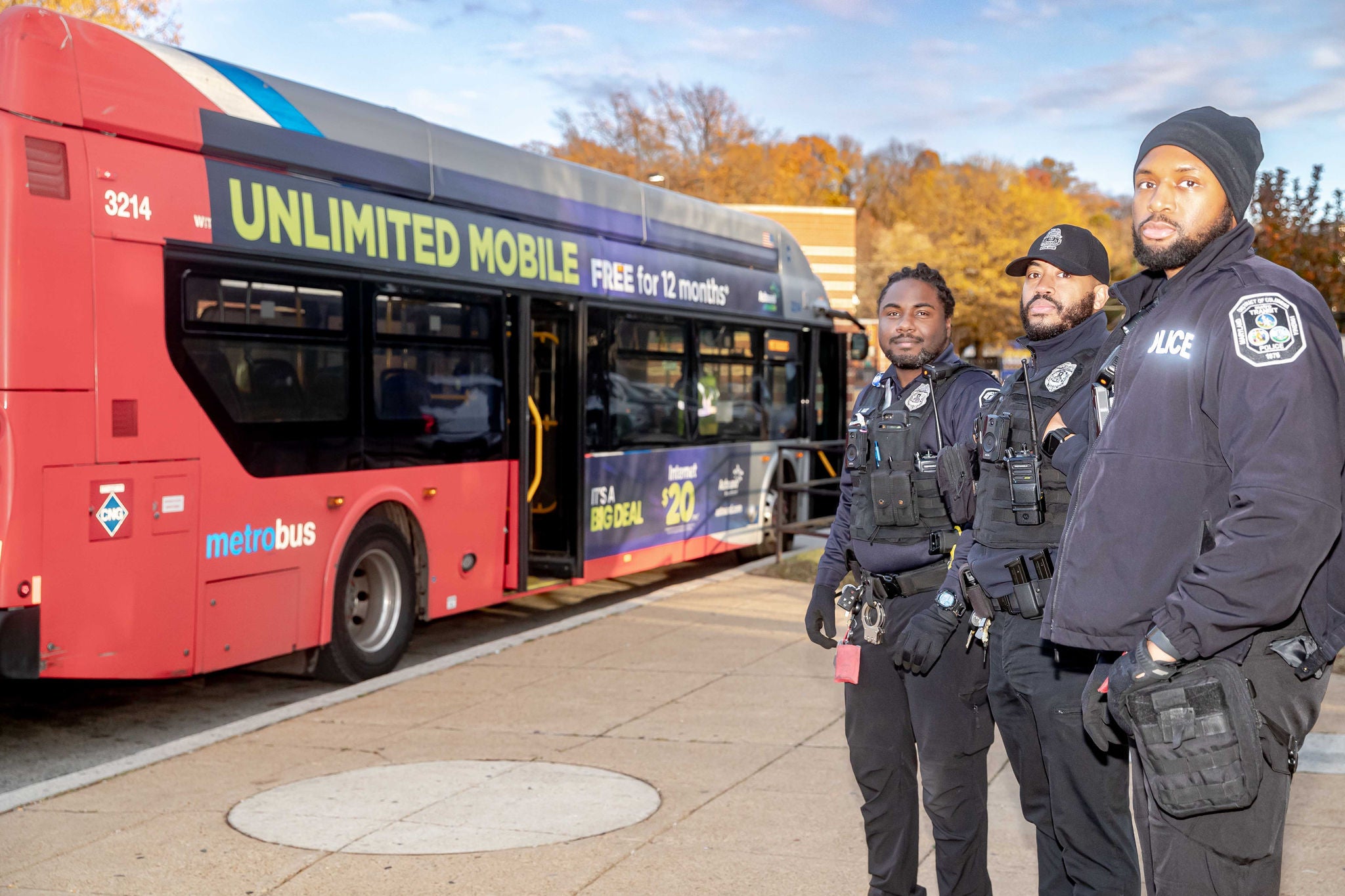
Bus safety and emergency response
Handling threatening or disruptive behavior
In cases of threatening or disruptive behavior aboard the bus, the operator can activate a silent alarm that alerts Central Control, who then contact the police. The disruptive passenger has no way of knowing the alarm has been activated or that police are on their way.
When the alarm is activated:
- The destination sign on most buses automatically changes to “EMERGENCY! CALL POLICE.”
- The exterior running lights flash to help approaching police identify the bus that sent the alarm.
Other emergencies
For any other type of emergency, the bus operator can contact Central Control using the bus radio to request the appropriate assistance.
Onboard and remote monitoring
All Metro Bus vehicles are equipped with closed-circuit television (CCTV) that provides views inside and outside the vehicle to support rider safety. Buses can also be monitored remotely via CCTV from the Metro Integrated Communications Center and the Metro Transit Police Department for situational awareness.
Emergency exits
All buses are equipped with multiple emergency exits, including:
- Emergency exit roof hatches
- Emergency rear door release
- Emergency exit windows
Safety programs and training
Metro Bus has earned the nation’s top bus safety award due to its strong safety record and aggressive safety programs. Bus operators receive refresher training every two years, with a primary focus on safety. Metro Bus also uses dedicated safety teams to ensure operators follow all safety rules.
Customer guidance
Always follow the bus operator’s directions in the event of an emergency.
Rail safety and emergency response
On trains
Call boxes located at the end of each Metro Rail car allow riders to report an emergency directly to the operator. The train operator is in constant radio communication with Central Control.
- Every rail car has an emergency door release located behind a panel next to the middle doors. The panel includes instructions for releasing the doors and evacuating passengers.
- The train operator has access to an emergency button that instantly locks all wheels on the train.
- Most trains are equipped with closed-circuit television to support rider safety. Some trains can be remotely monitored via closed-circuit television from the Metro Integrated Command and Communications Center and Metro Transit Police Department for situational awareness.
Always follow the train operator’s directions in the event of an emergency.
In stations and along the right-of-way
- Do not run in the station.
- When waiting for a train, stand near other passengers and away from the platform’s granite edge.
- Listen for instructions over the loudspeaker system if station evacuation is necessary.
- Promptly leave the platform after exiting the train.
- If you need directions, ask the Metro station manager.
Additional safety features
- Call boxes mounted on pylons on station platforms allow passengers to report emergencies to the station manager.
- Closed-circuit video cameras cover all areas of the station, with monitors located in the station manager’s kiosk.
- Clear, uninterrupted sight lines and enhanced lighting throughout stations reduce shadowed areas and places where criminals could hide.
- Emergency call boxes are located at the far ends of station platforms and every 800 feet along the tracks. Marked by blue lights, these boxes provide a direct line to Central Control and include a button to shut down third-rail power in extreme emergencies.
- Flashing lights along the platform edge warn of approaching trains. A recessed area beneath the platform edge provides emergency shelter for anyone who falls onto the tracks. Anyone using this area should avoid touching the train, as exposed components beneath the car carry high-voltage electricity.
- Special antennas run through all tunnels to ensure reliable communication for police and fire departments responding to underground emergencies.
- Metro provides a specially designed emergency evacuation cart for passengers unable to walk from the rail right-of-way.
- Chain-link fences prevent people from crossing outdoor rail tracks. If a fence is struck and becomes broken or tilted, an alarm alerts Central Control and automatically stops any nearby rail trains.
Integrated Command and Communications Center
- The Metro Integrated Command and Communications Center has a computer display showing the precise location of every train and bus in the system.
- The Metro Integrated Command and Communications Center also has a hotline to every police and fire department in the region.
Safety tips
Escalators
Tips on escalator safety: Metro Rail escalator safety page.
Panhandling
- Panhandling and soliciting of any kind are prohibited on Metro.
- Donate your money where it can do the most good by supporting local social service programs.
Help prevent theft and fraud
Take precautions to protect your valuables:
- Do not purchase a Metro farecard or pass from people on the street. It may be counterfeit.
- To prevent others from knowing where and how much money you are carrying, purchase a Smart Trip card or a multi-ride farecard.
- Keep jewelry and other valuables out of sight. Turn rings so precious stones face the palm of your hand.
- Keep a firm grip on your purse, but avoid wrapping the strap around your hand or wrist.
- Use a purse with a secure clasp. Keep it close to your body and your hand on the clasp.
- Carry your wallet inside your coat or a side trouser pocket, never in a rear trouser pocket. Place a rubber band around your wallet so you feel resistance if it is removed.
- Beware of loud arguments or commotions that may be staged to distract you while your pocket is picked.
- If your pocket is picked, yell out immediately to warn others. Do not be afraid to shout. Tell the train or bus operator and request police assistance.
- Avoid standing near rail car doors to reduce the chance of being crowded or bumped. If you are jostled, a pickpocket may be responsible.
- Never sleep on a train or bus.
Tips on preventing crimes from the MTPD
Help prevent auto theft
Every 20 seconds, a car is stolen in the United States. To help prevent auto theft:
- Park in busy, well‑lighted areas.
- Lock your car and take your key.
- Use an anti-theft device.
- Take valuables with you or lock them in the trunk.
- Use caution when hiding an extra key; thieves know common hiding places.
- Keep your driver’s license with you and store the vehicle registration out of sight. If convenient, take the registration with you as well.
- Have your car key ready as you approach your car.
- Be aware of people near you, especially at night.