
Proposed Changes
Effective on or around July 1, 2026.
Overview
WMATA is committed to maintaining the safety, reliability, and affordability of its system by investing in its assets - from rail stations, tracks, and traction power infrastructure to the vehicles, maintenance facilities, and cooling systems - and providing a better transit experience for hundreds of thousands of customers each day.
The proposed FY2027 capital budget of $2.1 billion and six-year capital improvement program of $13.5 billion (including required debt service and revenue loss from capital projects) include investment in ongoing projects, prioritized system preservation and renewal needs, and investments to provide safe and efficient service delivery informed by asset management and reliability plans.
Capital program publications detail the following:
- Capital Program Strategy outlining the vision and goals for capital investments.
- Six-year Capital Improvement Program investments of $13.5 billion and a FY2027 capital budget of $2.1 billion to fund priority investments constrained by affordability and delivery capacity.
Major capital program investments to further improve service and customer experience include:
- Railcars and Rail Facilities: Major vehicle investments include the 8000-series railcar acquisition program. Major facilities and systems investments include rail vehicle scheduled maintenance program facility improvements and railyard state of good repair.
- Rail Systems: Major investments include Train Control Room Rehabilitation, Track Circuit Cable Testing and Replacement, Switch Machine Replacement, Rail Power System Rehabilitation, Radio Infrastructure Replacement, and Fiber Installation.
- Track and Structures Rehabilitation: Major investments include track rehabilitation and maintenance; tunnel ventilation demonstration and water leak mitigation demonstration on the red line; and bridge and aerial structural rehabilitation.
- Station and Passenger Facilities: Major investments include standpipe systems and tunnel emergency egress; parking garage and surface lot rehabilitation, station entrance canopies, and elevator rehabilitations; digital signage and wayfinding, lighting, and fare payment modernization.
- Bus, Bus Facilities, and Paratransit: Major vehicle investments include bus acquisition and rehabilitation and paratransit vehicle purchases. Major facilities investments include Northern and Bladensburg garage replacements and electrification; bus shelter replacement, customer information electronic displays, and bus priority program.
- Operations and Business Support: Major investment include a modern training facility, computing infrastructure state of good repair; Enterprise Resource Planning (ERP) System Replacement; Asset Management System Upgrade; service vehicle replacement; and environmental compliance.
The six-year plan includes reimbursable projects such as the Purple Line.
|
Capital Investment Categories ($M) |
FY2027 Proposed Budget* |
FY2028-FY2032 Plan* |
Six-Year Total* |
| Railcars and Railcar Facilities | $372 | $2,013 | $2,385 |
| Rail Systems | $288 | $1,682 | $1,970 |
| Track and Structure Rehabilitation | $254 | $1,612 | $1,866 |
| Stations and Passenger Facilities | $327 | $1,253 | $1,580 |
| Bus, Bus Facilities, and Paratransit | $340 | $1,755 | $2,095 |
| Operations and Business Support | $282 | $1,123 | $1,405 |
| Total Capital Investments | $1,862 | $9,439 | $11,301 |
| Revenue Loss from Capital Projects and Other Needs | $22 | $110 | $130 |
| Debt Service - Dedicated Funding | $254 | $1,813 | $2,067 |
| Total Capital Program Cost | $2,137 | $11,361 | $13,498 |
*FY2027-FY2032 Plan capital investment category allocation subject to change as project costs and schedules are refined; columns may not sum due to rounding.
|
Funding Sources ($M) |
FY2027 Proposed Budget* |
| Formula and Other Grants | $517 |
| The Passenger Rail Investment and Improvement Act of 2008 (PRIIA) |
$144 |
| Subtotal Federal Grants | $661 |
| District of Columbia | $348 |
| State of Maryland | $322 |
| Commonwealth of Virginia | $299 |
| Subtotal State and Local Contribution | $970 |
| Jurisdiction Reimbursable Projects | $60 |
| Debt and Other Funding Sources | $284 |
| Prior Year Funding | $163 |
| Grant Total | $2,137 |
*FY2027 Funding Sources are estimates and may change; columns may not sum due to rounding.
WMATA's FY2027 Proposed Operating Budget (excluding reimbursables and debt service) of $2.7 billion is 5.1 percent higher than the FY2026 operating budget. At $651 million, total revenue is projected to be 15.4 percent higher than FY2026. Jurisdictional subsidies of $1.963 billion fund 72 percent of Metro's operating budget.
The FY2027 Proposed Budget service plans are designed to maximize service within available funding, while meeting growing demand. WMATA is advancing service efficiencies through bus schedule optimization, train automation, and the refinement of 6-car and 8-car trains to improve reliability and travel times. Service improvements proposed for FY2027 include targeted increases in Metrobus frequency and coverage to address crowding and on-time performance challenges; continued streamlining of the Better Bus Network informed by Year One results; and Metrorail enhancements that increase weekday, evening, and late-night frequency and add peak-period capacity. Metro will maintain FY2026 fare levels for FY2027.
Proposed Operating Budget
| ($M) |
FY2025 Actual |
FY2026 Budget |
FY2027 Proposed |
| Total Revenue | $594 | $564 | $651 |
| Gross Expenses | $2,531 | $2,607 | $2,740 |
| Preventive Maintenance Transfer | ($89) | ($109) | ($126) |
| Net Expenses | $2,442 | $2,498 | $2,614 |
| Gross Subsidy | ($1,848) | ($1,934) | ($1,963) |
| Prior Year Savings | $0 | $28 | $0 |
| Federal Relief | $123 | $0 | $0 |
| Jurisdictional Contribution | $1,753 | $1,906 | $1,963 |
| Operating Result | $28 | $0 | $0 |
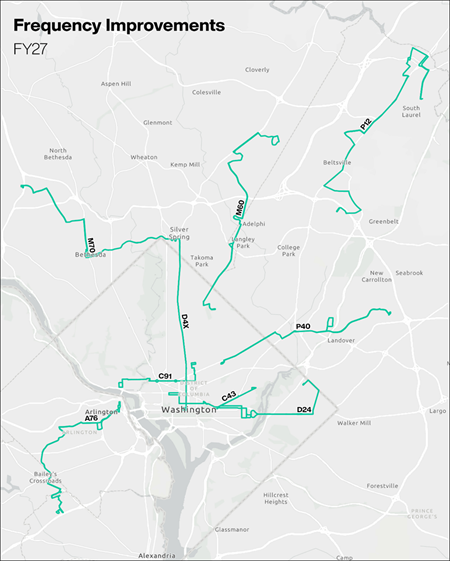
Frequency Improvements
Reduce customer wait time with more frequent service.
| Route | Day | Time Period | Current Headway | Proposed Headway |
| Frequency in minutes | ||||
| A76 | Mon-Fri | Morning & afternoon rush between Ballston & Mark Center | 30 | 15 |
| C43 | Mon-Sun | Non-rush | 40 | 30 |
| C91* | Mon-Fri | Morning & afternoon rush | 20-30 | 20 |
| Midday and Evening |
30 | 20 | ||
| Late Night | 40 | 30 | ||
| Sat-Sun | All Day | 30 | 20 | |
| Late Night | 40 | 20-30 | ||
| D24* | Mon-Sun | Non-rush | 30 | 20 |
| D4X | Mon-Fri | Non-rush | 12 | 10 |
| M60 | Mon-Sat | 3:30-5:30 p.m. | 12 | 10 |
| Mon-Sun | 9 p.m. - 12 a.m. | 30 | 20 | |
| M70 | Mon-Sun | 9-11 p.m. | 30 | 20 |
| P12 | Mon-Fri | Morning and afternoon rush |
45 | 30 |
| P40 | Mon-Fri | 9 p.m.- 2 a.m. | 15-45 | 15-30 |
| Sat-Sun | 9 p.m. - 2 a.m. | 50 | 30 | |
*Addition to Frequent Service Network
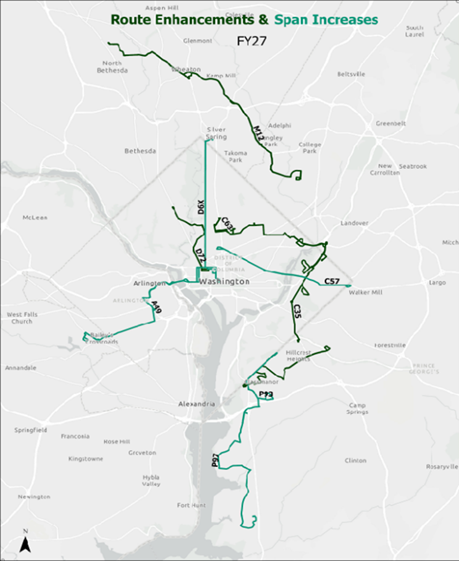
Route Enhancements and Removals
Streamline service for easier, more consistent travel on more days and times
| Route | Day | Time Period | Current Start-End |
Proposed Start-End |
Description |
| C35 | Mon-Fri | Non-rush | Deanwood - Fort Dupont | Deanwood - Naylor Rd | All weekday trips to Naylor Rd |
| C63 | Mon-Sun | All times | Deanwood - Washington Hospital Center | Deanwood - Georgia Av- Petworth | Extend service to Georgia Av-Petworth (started 12/25/2025) |
| D72 | Mon-Sun | Midday, Evening All Day |
Mt. Pleasant - Lafayette Square | Mt. Pleasant or Van Ness - Lafayette Square | Every other trip from Mt. Pleasant to Van Ness |
| Mon-Fri | Late Night | Mt. Pleasant - Lafayette Square | Van Ness - Lafayette Square | All trips from Mt. Pleasant to Van Ness | |
| M12 | Weekday | Rush Only | Every other trip to Hyattsville Crossing | Every trip to Hyattsville Crossing | All trips to Hyattsville Crossing |
| P93 | All days | All times | Suitland-Birchwood | Suitland-Eastover | Operate between Suitland and Eastover, adjust P97 to serve Birchwood* |
*Some reduction in service frequency and span compared to P93
Span Increases
Expand service hours and days to provide better coverage where riders need it
| Route | Day |
Current Service Span |
Proposed Service Span |
Description |
| A49 | Mon-Fri | 5:30-9 a.m. | 5- 9 a.m. | Begin morning peak at 5 a.m., afternoon peak at 3:30 p.m. |
| C57 | Mon-Fri | 7-9 a.m. | 6-9 a.m. | Begin morning peak at 6 a.m. |
| D6X | Saturday | 6 a.m.-11 p.m. | 6-12 a.m. | Run until 12 a.m. (midnight) on weekends |
| Sunday | 6 a.m.-9 p.m. | 6-12 a.m. | ||
| Mon-Fri | 4 p.m.-7 p.m. | 3:30-7 p.m. | ||
| P97 | Sat-Sun | No service | 6:30 a.m. - 7:30 p.m. | Add weekend service, improve off-peak service and reliability |
New Route/Service Proposals: Northern Virginia Transportation Commission I-66 Commuter Choice Grant
This grant opportunity allows Metro the chance to add service recommendations from the Better Bus Network Redesign (BBNR) Visionary Network within Northern Virginia.
|
Proposed Route |
Day |
Proposed Span |
Proposed Headway Frequency in minutes |
Description |
| A6X | Mon-Fri | 5:15-8:15 a.m. and 3:30-7 p.m. |
20 | New Limited Stop service: Dunn Loring - Pentagon - Crystal City |
| F2X | Mon-Fri | 5:30-9 a.m. and 3-7:15 p.m. |
15 | New Limited Stop service: Spring Hill - Mark Center - West Alexandria |
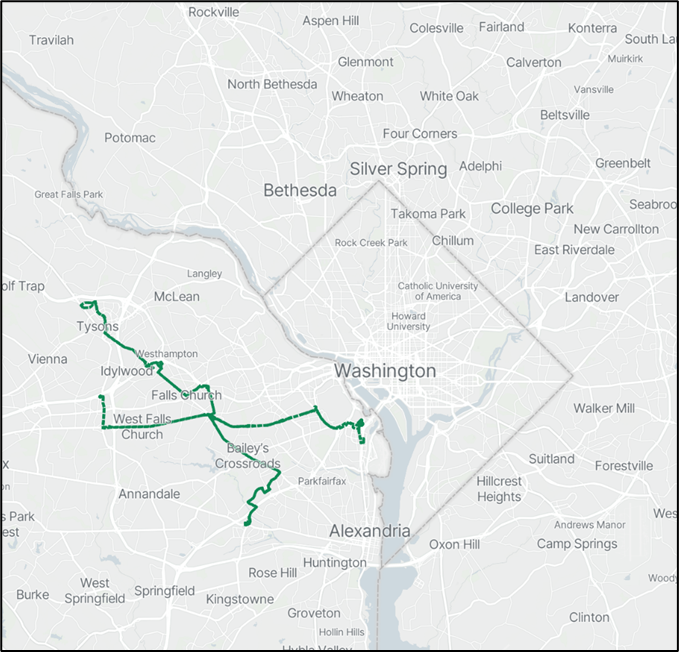
Note: Implementation of these services is subject to completion of Northern Virginia Transportation Commission (NVTC)'s Commuter Choice Grant Review process to include approval of projects by the Commonwealth Transportation Board (CTB).
Service Frequency Changes
-
Orange, Silver, Blue lines: More frequent weekday service (morning, midday and evening)
Operate Orange, Silver and Blue lines every 10 minutes, an improvement from the current 12-minute headway, during the morning, midday, and evening periods on weekdays, to support off peak demand and encourage ridership growth with more frequent all-day service.
-
Red Line: More frequent late-night service
Operate Red Line trains every 7 to 8 minutes, improved from every 10 minutes, during the late-night period from 9:30 p.m. until closing, seven days a week, to boost capacity in both directions.
Service Pattern Changes
-
Orange, Silver, Blue lines: More frequent service during busy commute times
Run slightly more often than every 10-minutes in the peak travel direction between 8-9 a.m. and 5-6 p.m. To provide this added service, Metro would remove the two Silver Line short trips* that currently operate during the weekday morning and afternoon peak periods. In effect, the additional trains would be distributed across the Orange, Silver and Blue lines instead of serving only the Silver Line.
PROPOSED FY2027 METRORAIL SERVICE LEVELS
Train frequency displayed in minutes
| Line | Service Pattern | Peak Service Monday - Friday |
All-Day Service Monday - Friday |
Late-Night Service Monday - Friday |
All-Day Service Saturday, Sunday, and Holidays |
Late-Night Service Saturday, Sunday, and Holidays |
| Red | Shady Grove to this Glenmont |
4 to 5 | 6 | 7 to 8 | 6 | 7 to 8 |
| Green | Greenbelt to Branch Av |
6 | 6 | 7 to 8 | 8 | 8 |
| Yellow | Huntington to Mt Vernon Sq* / to Greenbelt* |
6 | 6 | 7 to 8 | 8 | 8 |
| Orange | Vienna to New Carrollton |
10*** | 10 | 15 | 12 | 15 |
| Silver | Ashburn to Downtown Largo** / to New Carrollton** |
10*** | 10 | 15 | 12 | 15 |
| Blue | Franconia-Springfield to Downtown Largo | 10*** | 10 | 15 | 12 | 15 |
We've marked headway improvements in FY2027. Metrorail service in grayed-out boxes differentiates proposed changes from existing service frequencies.
*Yellow Line trains alternate between terminating at Mt. Vernon Square and Greenbelt, with every other Yellow Line train operating to Greenbelt instead of terminating at Mt Vernon Sq. Frequency in the Mt. Vernon Square to Greenbelt branch is double that shown in the table.
**Silver Line trains alternate between terminating at Downtown Largo and New Carrollton, with every other Silver Line train travelling to New Carrollton instead of Downtown Largo. Frequencies in the branches between Stadium-Armory to New Carrollton/to Downtown Largo are double those shown in the table.
*** Metro is considering running service slightly more frequently than every 10 minutes on the Orange, Silver, and Blue lines during the peak commute hour of each weekday morning and afternoon in the peak direction of traffic. This service addition would replace the two Silver Line short trips* in the peak weekday morning and afternoon commute hours on the Silver Line.
All-Day Service: Baseline service frequency from opening until 9:30 p.m.
Peak Service: Increased service frequency on weekdays (Monday-Friday) from 7:00 a.m. to 9:00 a.m. and 4:00 p.m. to 6:00 p.m.
Late-Night Service: Service frequency from 9:30 p.m. to closing.
The FY2027 Proposed Budget maintains MetroAccess service at FY2026 levels, with no planned adjustments.
The FY2027 Proposed Budget maintains fares at FY2026 levels, with no planned adjustments.