Public invited to comment on the refresh of Metro’s Strategic Transformation Plan
 Metro is inviting the public to weigh in on a refresh of our Strategic Transformation Plan, Your Metro, The Way Forward.
Adopted in Feb. 2023, the plan serves as both a long-term strategy and a tool for annual priority setting as Metro works to meet the evolving needs of its customers, employees, and the region.
Since then, Metro has accomplished many of the goals in the plan like reducing Part 1 (serious) crimes by 50%, launching the Better Bus Network Redesign, and reducing fare evasion on rail by more than 82%. Now, the organization wants to update the plan, setting new aspirational goals for the next three years.
The public can help shape the Transformation Plan
Starting Oct. 11, the public can view the draft updated plan and weigh in at wmata.com/strategicplanrefresh. The comment period runs through Nov. 4.
A hybrid in-person and online public hearing is set for 6:30 p.m. on Oct. 30, at the Northern Virginia Transportation Commission headquarters at 2300 Wilson Blvd. in Arlington, Virginia.
The Metro Board of Directors will vote on the plan later this year.
What’s in the updated plan
Metro aims to be a world-class transit system that is the National Capital Region’s trusted way to move people safely and efficiently.
The refresh streamlines the plan around three goals: Service Excellence, Talented Teams, and Financial and Organizational Efficiency, with Regional Partnership and Long-Term Transit Planning recognized as a critical cross-cutting enabler across all goals. Metro is already emphasizing efficiency by saving hundreds of millions of dollars in recent budget years.
“We can’t do anything without our regional partners and their support,” said Metro General Manager and CEO Randy Clarke. “At the same time, Metro has to do everything in our power to make sure we are spending the region’s resources wisely and providing the most value as possible.”
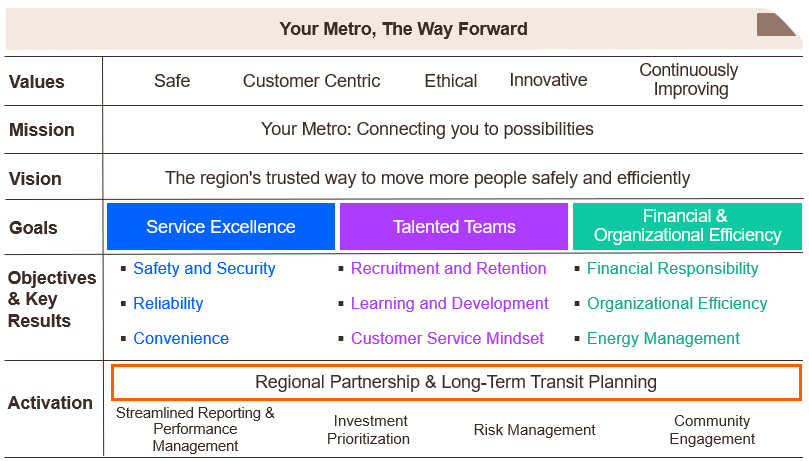 The update includes both internal and external facing goals and streamlined priorities so staff can deliver on Metro’s ambitions.
“This planning process is a valuable opportunity for customers and stakeholders across our region to help shape Metro’s future,” said Metro Board Chair Valerie Santos. “As our communities evolve, so must our transit system. With public input, we can ensure the Strategic Transformation Plan— a dynamic, forward-looking roadmap for the next three years— remains responsive to change, is grounded in community priorities, and meets the region’s future needs.”
To date, Metro has conducted workshops and over 40 interviews with the Board and staff, surveys, staff town halls, and had conversations with transit peers, regional partners, and community groups to help shape the updates to the Strategic Transformation Plan.
Strategic Transformation Plan accomplishments so far
Metro has met or exceeded several of the original benchmarks in the 2023 Strategic Transformation Plan:
- Maintained 85% or better customer satisfaction for rail and bus.
- Reduced Part 1 Crimes by over 50%.
- Implemented Tap. Ride. Go. credit and debit card payments on rail.
- Established the MTPD Criminal Justice Academy.
- Accelerated hiring through job fairs, helping fill frontline roles quickly.
- Launched tech-driven employee training for critical safety roles.
- Launched Better Bus Network in 2025 to improve frequency and coverage.
- Served 250 million trips in 2024.
- Broke ground on five transit-oriented development projects.
- Reduced fare evasion on rail by 82%.
- Identified $532 million in cost savings over past two years
The Washington Metropolitan Area Transit Authority (WMATA), known as Metro, is the region’s leading public transportation provider, serving a population of approximately four million people across Washington, D.C., Maryland, and Virginia within a 2,054-square-mile jurisdiction. With a network of six rail lines, 98 stations, 125 bus routes, and a door-to-door paratransit service, Metro is the second busiest transit system in the United States with a $5 billion operating and capital budget. Since 2022, Metro has completed multiple transit-oriented development projects that have brought $15 million in tax revenue to the region from housing, office, and retail space in our community. Safety and security are a priority at Metro. Over 30,000 cameras monitor the system, and Metro is currently at an 8-year crime low with fare evasion down 82%. In 2025, the American Public Transportation Association (APTA) named Metro the Transit Agency of the Year in recognition of industry-leading ridership growth, record high customer satisfaction, a newly redesigned Bus network, expanded rail service, and improved customer experience.